[an error occurred while processing this directive]

Advanced Ultrasound in Diagnosis and Therapy ›› 2026, Vol. 10 ›› Issue (1): 74-78.doi: 10.26599/AUDT.2026.250062

• • 上一篇    


  • 收稿日期:2025-07-17 修回日期:2025-09-27 接受日期:2025-10-15 出版日期:2026-03-31 发布日期:2026-03-30

Ultrasound-Guided Portal Vein Puncture for The Treatment of Hepatic Portal Venous Gas: A Case Report

Si Jiahaoa, Zhang Yea, Wang Shuaiyangaa, Hao Liuweia, Duan Shaoboa,*()   

  1. aDepartment of Interventional Ultrasound, People's Hospital of Zhengzhou University, Henan Provincial People's Hospital, Zhengzhou, 450003, China
  • Received:2025-07-17 Revised:2025-09-27 Accepted:2025-10-15 Online:2026-03-31 Published:2026-03-30
  • Contact: Department of Interventional Ultrasound, People's Hospital of Zhengzhou University, Henan Provincial People's Hospital, Zhengzhou, 450003, China, e-mail: dustin2662@163.com (SB D)

Abstract:

Background

Hepatic portal venous gas (HPVG) is a critical imaging finding, often indicative of an acute abdominal catastrophe of gastrointestinal origin. The condition progresses rapidly and is associated with an extremely high mortality rate. Conventional conservative management or surgical intervention carries significant risk, particularly for perioperative patients.

Case Summary

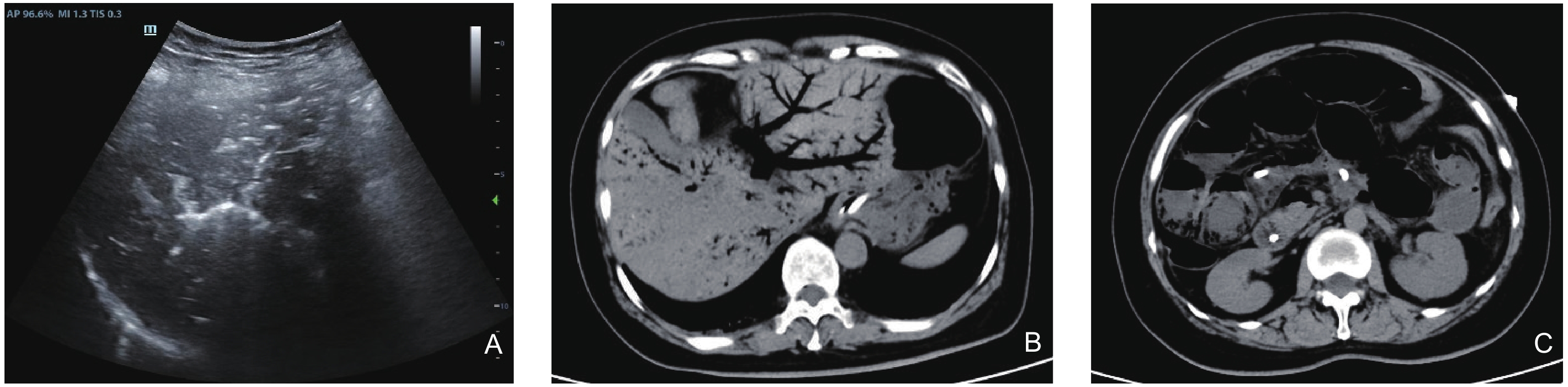
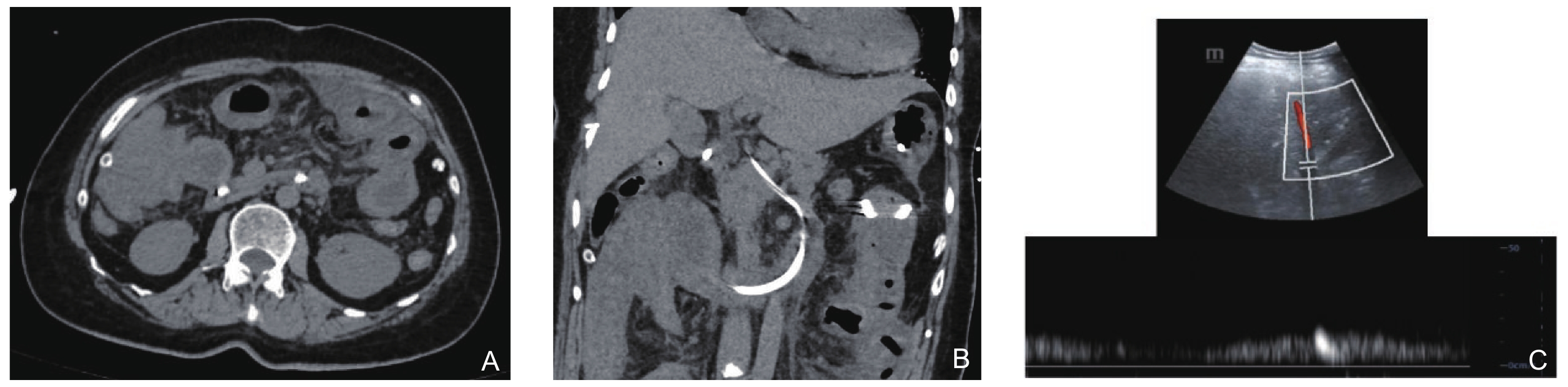
A 64-year-old female patient was admitted to our hospital on August 1, 2023, with a chief complaint of abdominal pain, distension, and cessation of defecation and flatus for one day. The diagnosis was small bowel obstruction, for which an endoscopic nasojejunal feeding tube placement was performed. On August 30, a follow-up abdominal CT scan revealed intrahepatic biliary duct dilation and HPVG. Due to clinical deterioration, the patient was transferred to the ICU. Following a multidisciplinary consultation, an ultrasound-guided portal vein puncture and catheterization was performed first. This intervention successfully alleviated the signs of HPVG, thereby reducing the risk for the subsequent laparotomy. The patient was ultimately successfully treated.

Conclusions

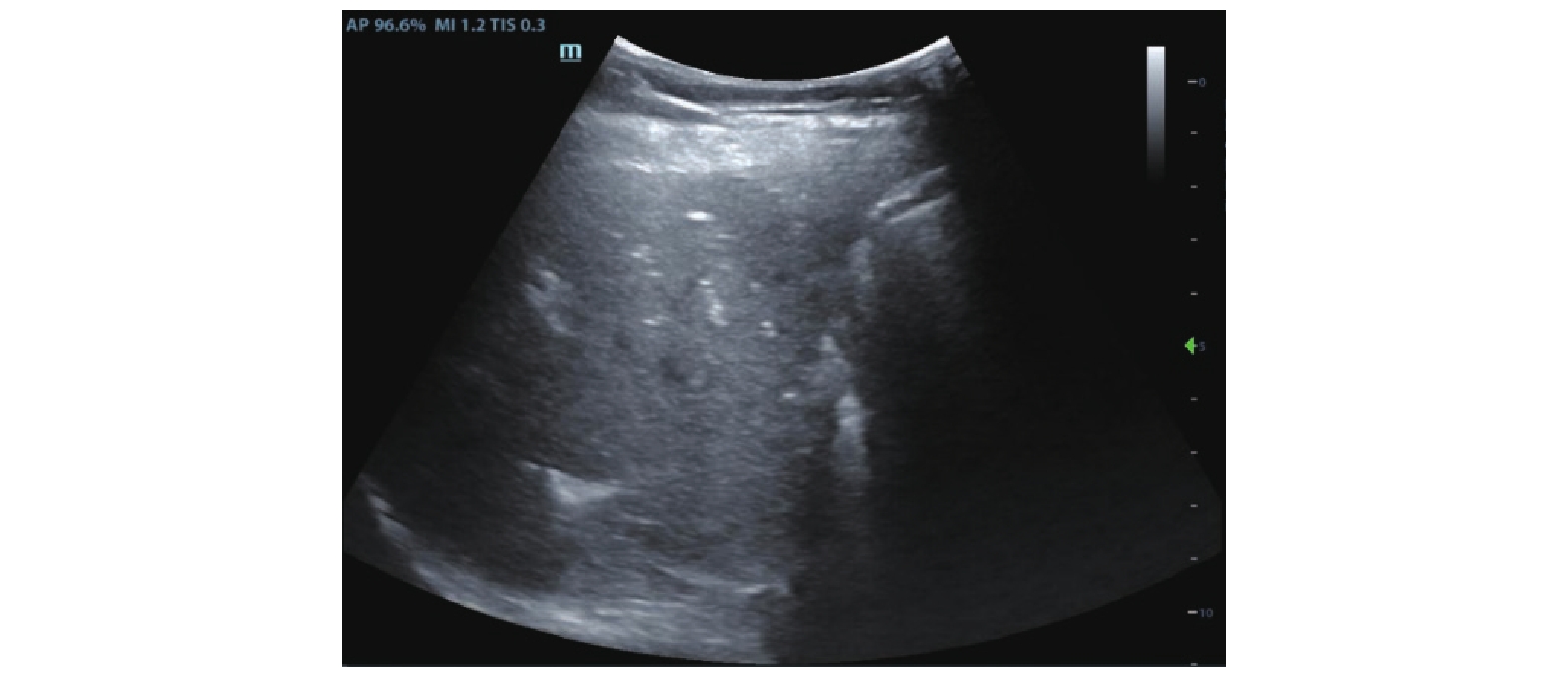
In this case, the hepatic portal vein was directly punctured under ultrasound guidance, and a PICC catheter was inserted into the portal vein. A mixture of blood and gas was successfully aspirated post-puncture. An immediate post-procedural scan revealed a significant reduction of gas within the intrahepatic portal veins, alleviating HPVG and mitigating the risk for the subsequent laparotomy. This demonstrates that this method can effectively provide direct relief from HPVG and offers a novel therapeutic approach for the management of similar cases.

Key words: Hepatic portal venous gas, Interventional ultrasound therapy, Ultrasound-guided, Acute intestinal obstruction

[1] Liu C, Wu CH, Zheng XD, Liu JP, Li CL, Zhao JY, et al. Hepatic portal venous gas: a case report and analysis of 131 patients using PUBMED and MEDLINE database. Am J Emerg Med 2021; 45: 506-509.
doi: 10.1016/j.ajem.2020.06.085
[2] Chen KW, Shin JS, Chi CH, Cheng L. Seizure: a rare and transient cause of portal venous gas. Am J Gastroenterol 1997; 92: 351-352.
[3] Zhang Y, Liu HL, Tang M, Wang H, Jiang HH, Lin MB. Clinical features and management of 20 patients with hepatic portal venous gas. Exp Ther Med 2022; 24: 525.
doi: 10.3892/etm.2022.11452
[4] Fujii M, Yamashita S, Tanaka M, Tashiro J, Takenaka Y, Yamasaki K, et al. Clinical features of patients with hepatic portal venous gas. BMC Surg 2020; 20: 300.
doi: 10.1186/s12893-020-00973-8
[5] Chevallier P, Peten E, Souci J, Chau Y, Padovani B, Bruneton JN. Detection of portal venous gas on sonography, but not on CT. Eur Radiol 2002; 12: 1175-1178.
doi: 10.1007/s00330-003-1899-3
[6] Zhou C, Kilpatrick MD, Williams JB, Rivers JF, Miller TA. Hepatic portal venous gas: a potentially lethal sign demanding urgent management. Am J Case Rep 2022; 23: e937197.
doi: 10.12659/ajcr.937197
[7] Nelson AL, Millington TM, Sahani D, Chung RT, Bauer C, Hertl M, et al. Hepatic portal venous gas: the ABCs of management. Arch Surg 2009; 144: 575-581.
[8] Higashi T, Hayashi H, Takeyama H, Arima K, Taki K, Takamori H, et al. Evaluation of patients with hepatic portal venous gas who can be treated with conservative therapy. Acute Med Surg 2015; 3: 16-20.
doi: 10.1002/ams2.125
[9] Moser A, Stauffer A, Wyss A, Schneider C, Essig M, Radke A. Conservative treatment of hepatic portal venous gas consecutive to a complicated diverticulitis: a case report and literature review. Int J Surg Case Rep 2016; 23: 186-189.
doi: 10.1016/j.ijscr.2016.04.042
[10] He C, Zhang J, Yuan B, Pang Y. Is reoperation required for patients presenting with hepatic portal venous gas after gastrointestinal surgery: a review of the literature. Ann Med 2024; 56: 2389293.
doi: 10.1080/07853890.2024.2389293
[11] Lichtenstein DA. BLUE-protocol and FALLS-protocol: two applications of lung ultrasound in the critically ill. Chest 2015; 147: 1659-1670.
[12] Lamperti M, Biasucci DG, Disma N, Pittiruti M, Breschan C, Vailati D, et al. European society of anaesthesiology guidelines on peri-operative use of ultrasound-guided for vascular access (PERSEUS vascular access). Eur J Anaesthesiol 2020; 37: 344-376.
doi: 10.1097/EJA.0000000000001180
[13] Li Z, Tang Y, Wang P, Ren J. Diagnosis and treatment of retroperitoneal infection. Surg Infect (Larchmt) 2021; 22: 477-484.
doi: 10.1089/sur.2020.126
No related articles found!
Viewed
Full text


Abstract

Cited

  Shared   
  Discussed   
No Suggested Reading articles found!
[an error occurred while processing this directive]